Best Irrigation Systems for Coffee Farming
Choosing the right irrigation system is one of the most important decisions a coffee farmer can make. A system that performs well on a flat lowland farm can fail entirely on a steep, shaded hillside.
With water costs, energy bills, and climate unpredictability all rising, the gap between a well-matched system and a poorly chosen one compounds with every season. This guide walks you through the most widely used irrigation systems for coffee farming, what each does well, where each falls short, and which farm profiles each suits best.
Drip Irrigation
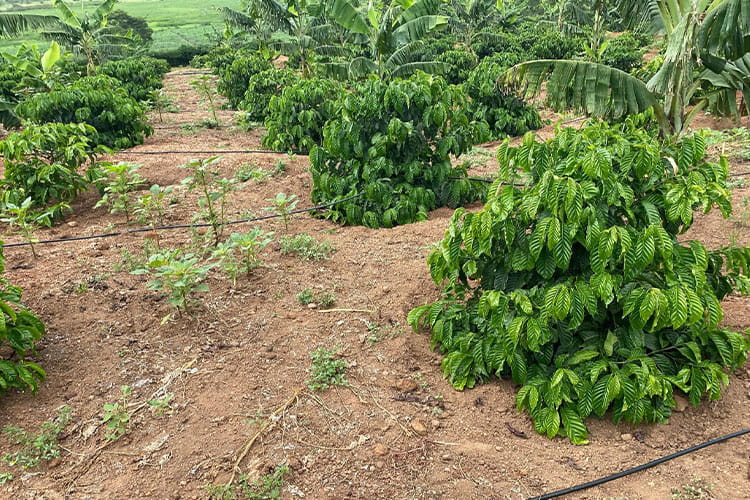
Drip irrigation is widely considered the gold standard for coffee, and for good reason. It delivers water directly to the root zone through a network of pipes and emitters, releasing a specific quantity at the base of each tree. Because water moves through the soil by capillary action rather than flooding the surface, losses to evaporation are negligible and the inter-row soil stays dry, which suppresses weeds and reduces chances fungal disease due to wet leaves. Water use efficiency typically reaches 90 to 95 percent, which means very little of what you pump/supply is wasted.
Drip systems handle slopes and terraces well, they are fully compatible with fertigation, delivering dissolved fertilizer directly through the irrigation water. Once installed and automated, they require minimal daily labour. The trade-offs are real, however. Upfront investment costs are significant. Filters must be cleaned regularly and emitters flushed to prevent clogging, particularly where water carries silt or organic matter.
A reliable pressurized water source or elevated storage tank is also essential. For medium to large farms where water is scarce and long-term efficiency matters, drip irrigation consistently delivers the strongest return on investment.
Overhead Sprinklers
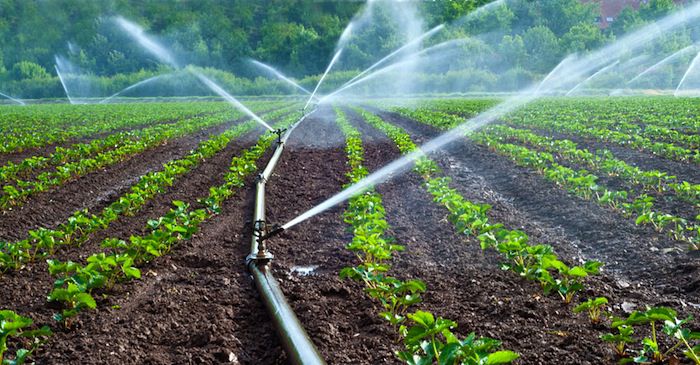
Conventional overhead sprinklers deliver water through rotating or fixed sprinkler heads mounted on riser pipes above the crop canopy. In mature coffee plantations, they are rarely the first choice. Spraying water through open air in warm conditions generates significant evaporation losses, and consistent canopy wetting elevates the risk of disease that can devastate yields if not managed aggressively. Efficiency typically falls between 65 and 75 percent.
Their most appropriate role in coffee production is in the nursery, where even soil moisture across seed beds and germination trays is critical and foliar wetting carries less risk. For large plantations, overhead sprinklers are also used as a cost-effective solution to irrigate large areas within the shortest periods of time.
Surface Irrigation
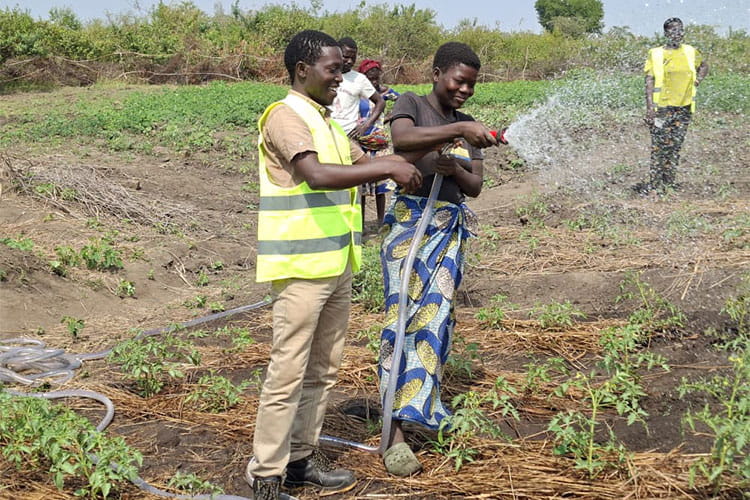
Furrow and basin irrigation are the oldest surface irrigation methods in use for coffee especially among smallholder farms. Water is directed from a river, canal, or storage pond along earthen channels running between coffee rows, or pooled in individual circular basins dug around each tree. For a smallholder farmer in a water-abundant area with flat to gently sloping land and limited capital, it can be a rational starting point.
The limitations, however, are severe. Efficiency rarely exceeds 50 to 60 percent, with large quantities of water lost to evaporation, runoff, and deep percolation below the root zone.
Water distribution is inherently uneven: trees at the head of a furrow run receive far more water than those at the tail, creating yield inconsistency across a single plot. Surface wetting promotes weed growth across the entire inter-row zone, adding to labour costs. On slopes, furrow irrigation carries a serious erosion risk.
Laser Spray Irrigation
Laser spray irrigation systems operate on a pipe network as drip systems but distribute water over a wider wetted circle, typically one and a half to four meters in radius per emitter/tape. They run at low pressure and are easier to install than full drip systems, making them a practical step up for farms transitioning away from furrow irrigation. However, their efficiency is lower than drip, generally in the range of 75 to 85 percent, because some water is lost to evaporation as it travels through the air before reaching the soil.
They are a good choice for coffee farms in high altitude areas. The broader wetted area they provide also benefits young trees whose root systems have not yet fully developed. The main caution is canopy wetting: regularly moistened foliage increases the risk of foliar diseases, so spacing and timing need to be managed carefully.
Choosing the Right Irrigation System
No single system is universally correct. Four key factors should drive your decision; farm size, terrain, water source, and financial resources. Farm size and terrain determine which systems are physically viable. Drip and laser spray systems handle slopes well, while overhead sprinklers and gravity furrows require flatter ground. Your water source and available pressure determine whether a pressurized system is feasible or whether gravity-fed storage is the better path.
Capital availability sets the realistic starting point, though it should not be the only consideration: a low-cost furrow system that wastes large quantities of every litre of water pumped may cost more in the long run than a drip irrigation system. Finally, water security matters enormously in regions where drought frequency is a risk. In such a case, the highest-efficiency system you can afford is always the right investment.
The right irrigation system is not the most expensive one available. It is the one that best matches your water source, terrain, crop stage, and operational capacity, and that you can actually maintain season after season. Start where your resources allow, plan your upgrade path, and keep detailed records from the first season as they will be your most valuable asset when it comes time to scale.