How to Expand Your Coffee Farm Using Irrigation: A Step-by-Step Strategy
Picture this: your coffee trees are healthy, your soil is well prepared, and your farm has room to expand; but the rain simply will not cooperate. Whether it arrives too late, too little, or all at once, rainfall alone is increasingly becoming unreliable for coffee farmers across Uganda. For a crop as water-demanding and sensitive as coffee, erratic weather does not just reduce your harvest, it puts a ceiling on how far your farm can grow. Irrigation removes that ceiling. It gives you control over your water, your timing, and ultimately your yield, and when you are thinking about expanding your coffee farm, irrigation is not merely a support system; it is the engine that makes expansion possible and profitable in the first place.
So how do you go about it?
Step 1: Understand Your Farm’s Water Requirements
Before you install a single pipe, you need to understand how much water your coffee requires and when. Coffee irrigation is not about flooding the field; it is about precision: delivering the right amount of water at the right growth stage and time.
Coffee has four key water-sensitive periods you must plan around; on-set of flowering, blossoming, berry expansion, bean filling, and post-harvest/continuous growth.
A sound approach is to pair your irrigation scheduling with regular soil moisture monitoring. Soil moisture sensors, or even simple field assessments of soil feel and colour, help you irrigate based on actual plant need rather than a fixed calendar, saving water and preventing both under- and over-irrigation.
Step 2: Plan Your Water Source
Expanding irrigation means securing a reliable water source that can meet your crop’s peak demand. For most coffee farms in Uganda, the primary options are surface water sources such as streams, lakes, and ponds, or groundwater sources such as shallow wells or machine-drilled deep wells.
Step 3: Plan Your Infrastructure
A gravity-fed irrigation system, where a reservoir is constructed at a high point on the farm and water flows downhill to the field, reduces or entirely eliminates pumping costs and is a particularly attractive option on farms with sufficient elevation change.
In contrast, water pump-driven systems can take advantage of Uganda’s plentiful solar energy, as well as hydroelectric power and generators.
Step 4: Choose the Right Irrigation System for Coffee
Not all irrigation systems are equally suited to coffee. The three main options used on coffee farms globally are drip irrigation, sprinkler irrigation, and flood irrigation.
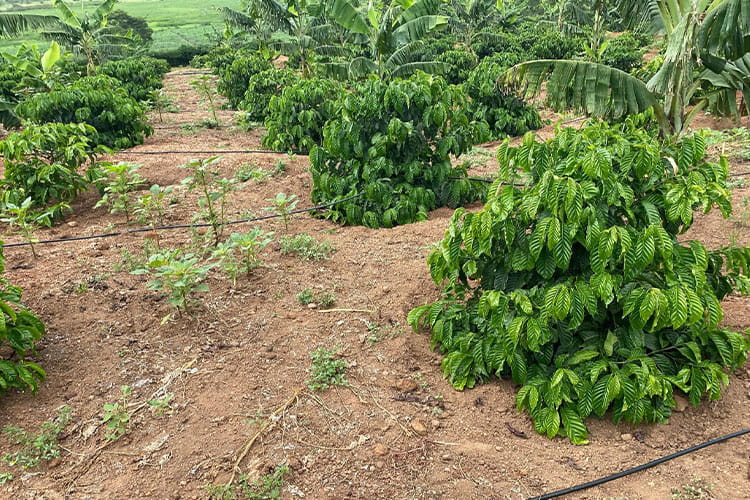
Drip irrigation delivers water directly to the root zone of each plant through a network of pipes and emitters installed along lateral lines. It is the most water-efficient system available for coffee, using approximately 40% less energy than alternative pressurized systems and enabling water savings of up to 50% compared to sprinklers when properly managed.
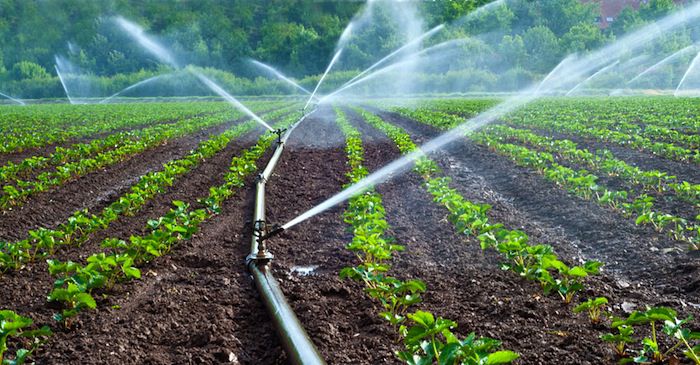
Sprinkler irrigation systems are well-suited to larger farms where laying individual drip lines to every plant would be prohibitively labor-intensive. The main trade-off with sprinklers relative to drip is higher water use through evaporation and greater sensitivity to wind drift.
Traditional basin or furrow flooding, where water is channeled into earthen basins around each tree, is the least efficient method for coffee and the most wasteful of water. Farmers using basin irrigation apply more than double the water their plants actually need, depleting groundwater resources and increasing the risk of nutrient leaching.
As you expand your farm, graduating away from basin irrigation to drip or sprinkler systems is not just good agronomics; it is an investment that protects your land’s long-term productivity.
Step 5: Book a Professional Irrigation System Design and Installation
A well-designed and installed irrigation system allows you to cultivate more land productively while using water more efficiently than a rain-fed setup. Whether you are farming on a small, medium, or large-scale, Sprinktech Limited has the expertise and the equipment to design an irrigation system that fits your farm and your expansion ambitions.
Bonus Tip: Expand Progressively, Not All at Once
One of the most common mistakes farmers make when expanding with irrigation is attempting to install the entire system at once. A better approach is phased expansion; beginning with your highest-value blocks or nursery, proving the system, learning from it, and then extending it to new areas as capital allows.
Start with your existing productive acreage if it is not yet irrigated. Document the yield improvement in the first full season. This data becomes the business case for your next phase of expansion and, if needed, your financing application guarantee. Sprinktech’ s team can help you design a system that is modular from the outset, so that each phase of expansion connects cleanly to what has already been installed.
The Bottom Line: Irrigation Is the Engine of Farm Growth
Expanding a coffee farm without irrigation is like building a road without knowing if it leads anywhere. You are at the mercy of weather conditions, which are entirely outside your control. Irrigation puts you in the driver’s seat, controlling when your plants flower, how uniformly your cherries develop, and ultimately how much coffee you produce each season.
Get in touch with our team today for a professional farm assessment and system design or recommendation, and let us start growing more coffee together.